About Kivitsisa

In 2018, Greenland’s five municipalities joined forces to set up the Kivitsisa Project. The municipalities working so closely together to set all primary and lower secondary schools on the same path in order to improve pupil learning was ground-breaking. Kivitsisa is also managed in close cooperation with the Department of Learning at the University of Greenland and the Greenland Agency for Education.
As the municipalities are very different, there are variations in the way in which the Kivitsisa Project is structured in each municipality, but common to all is the direction of the project and the will to cooperate and support each other.

The importance of the Kivitsisa Project

The aim of the Kivitsisa Project is to improve the level of learning in primary and lower secondary schools. iPads for everyone and improved Internet connection can – if used correctly – provide a wide range of exciting opportunities in teaching: pupils are able to gather, create and communicate knowledge, they are able to collaborate with other pupils both nationally and internationally, distance learning can be set up and much more. Both teachers and school managers are continuously trained in the project’s possibilities. In order to achieve the objective, namely that these tools consolidate pupil learning, new forms of collaboration are included to ensure that good practice is shared.

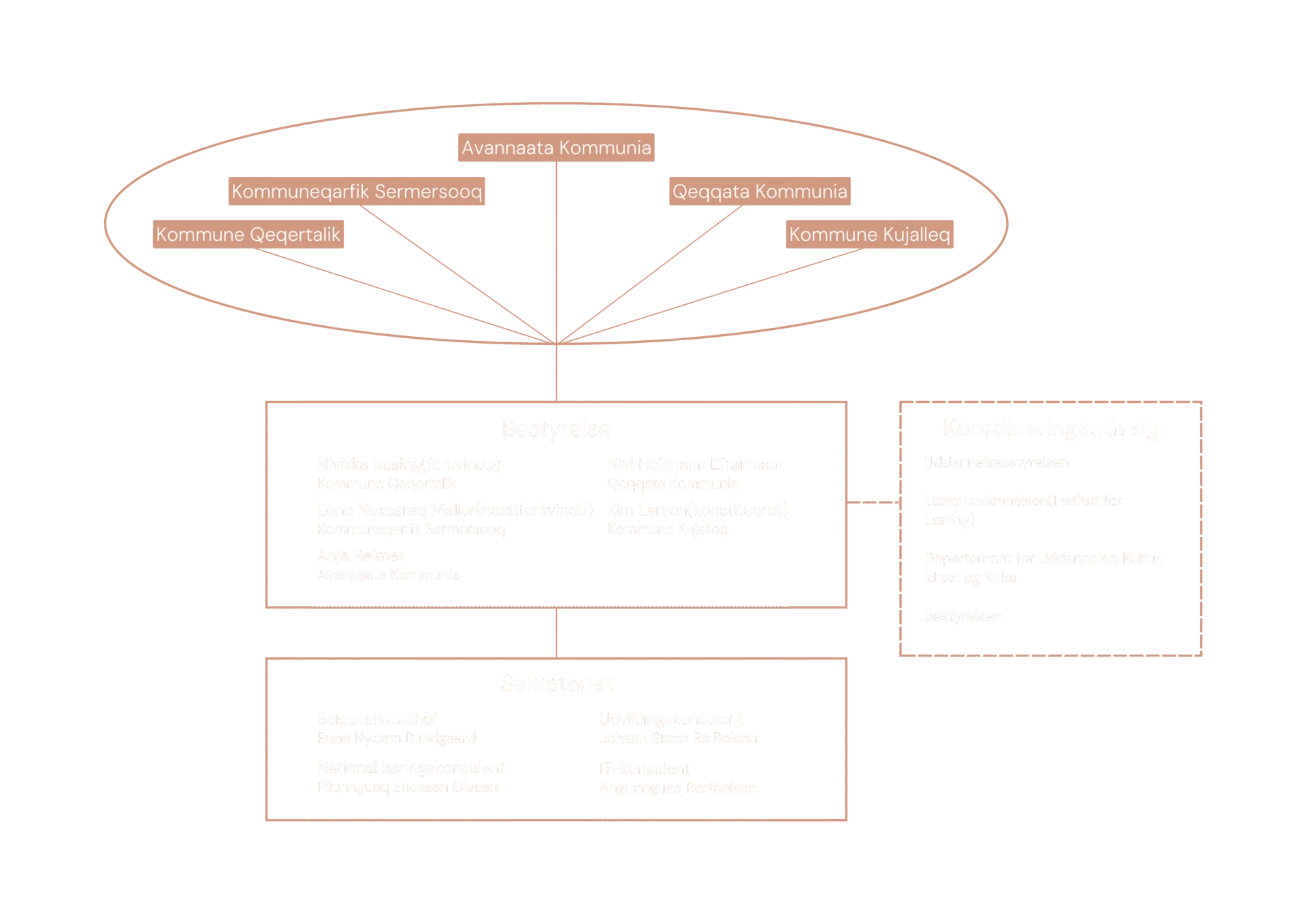
Cooperation at all levels is high on the list of Kivitsisa’s objectives. Kivitsisa has also found great support outside the world of municipal schools. Development work is based on funding from four large foundations: Villum Fonden, Hempel Fonden, A.P. Møller og Hustru Chastine Mc-Kinney Møllers Fond til almene Formål and Oak Foundation Denmark. These four foundations are represented in Kivitsisa’s steering group as are close partners and stakeholders who actively wish to support the project. An overview of Kivitsisa’s organisational structure can be found below. 

The organization of Kivitsisa

New forms of skills development

A transformation of the learning environment at individual schools is only possible if teachers know how to utilise the potential of online learning. The Kivitsisa Project has invented and made use of a wide range of collaboration and skills development initiatives. The vast majority of these initiatives are digital – or a mix between online and physical meetings. This has made it possible to establish long, continuous courses that have never been possible before.

All of Kivitsisa’s skills development initiatives focus on roll-out that is as much an integrated part of the teacher’s everyday life as possible and with sustainability as a stated objective. Sustainability should be understood as meaning that the goal is national capacity-building which future-proofs a stable and high level of education to enable participants themselves to manage skills development in the years to come. Fundamentally, the Kivitsisa Project is based on the fact that the best way to learn is to teach others. This has been demonstrated, for example, by the fact that external consultants most often help and support local educators, teachers, mentors or consultants in their preparation of specific skills development initiatives. The absolute key role in this kind of skills development belongs to ‘ikiortit’ – which means ‘those who help’.

Ikiortit – those who help

Ikiortit are mentors in schools. Their task is to support colleagues as an integrated part of their day-to-day teaching. Ikiortit organise small workshops for their colleagues, just as they help prepare, implement and evaluate lesson plans. Ikiortit are available for ongoing guidance and professional feedback when their colleagues need it. Ikiortit can be found in all major schools. They also help teachers at nearby smaller schools, just as they offer online courses to teachers across Greenland.

The Kivitsisa Project has provided training for ikiortit to assist their colleagues. This takes place at ‘Ikiortit Naapiffik’ – physical or online conferences and workshops, where they meet and are trained in pedagogy, didactics, teaching techniques and supervision. This means that an ikiorti network has been created across Greenland. Ikiortit also receive ongoing inspiration through monthly webinars and ongoing professional back-and-forth with Kivitsisa’s project manager. The principle is that learning anything that you do not pass on is prohibited.
Scroll to Top
×