
Experiences gained from Kivitsisa’s
distance learning programmes
For many years, there has been a great deal of talk about distance learning in primary and lower secondary schools, and many attempts have been made to incorporate it into the learning environment. With improved Internet connection in schools and iPads for all pupils, we are now well on our way to having the technical foundation that we need. But all previous attempts show that distance learning is not something you just do. It requires entirely new reflections on teaching methods and collaboration. An entirely new form of teaching requires a completely new didactics. In order to achieve such distance learning didactics, the Kivitsisa Project rolled out a distance learning programme in the academic year 2021/22. 16 teachers completed various forms of distance learning in different places, at different levels and in different subjects.
There have been experiments involving the roles of both teacher and pupil, technical setups, collaboration between schools and, not least, teaching methods themselves. All this was done to allow everyone to understand the way in which distance learning works best in different contexts.
The five teachers and researchers from the Department of Learning at the University of Greenland, Line Groth Nielsen, Ivaaq Kriegel, Louise Pindstrup Andersen, Anders Øgaard and Rikke Ørngreen have, in partnership with the Kivitsisa Project, followed the teaching closely and looked at the lessons that could be learnt.


Guidance material
On the Kivitsisa Project, distance learning has been used in many different ways, and the Department of Learning at the University of Greenland has been responsible for following up on the lessons learnt in the academic year 2021-2022. We see that distance learning helps schools become increasingly professional.
Teachers and pupils enjoy distance learning, and schools are assisted to ensure that pupils receive qualified teaching in all subjects. But, of course, schools face both potential opportunities as well as barriers.
From the experience gained from Kivitsisa’s distance learning project, we have seen that good relationships and effective cooperation between distance learning teachers, pupils, local teachers and school management are important ingredients for distance learning to succeed.
We have also seen that well-functioning technology, good organisation and explicit choices on didactics have a great impact on the results of the distance learning that the pupils ultimately receive.
These pages containing inspiration and ideas are based on three different distance learning models, which teachers, schools and municipalities can choose to apply or be inspired by: The RURAL, COLLEAGUE and SUBJECT TEACHER models.
No matter which model is chosen, there are a number of different roles that need to be considered and a range of factors that affect distance learning.
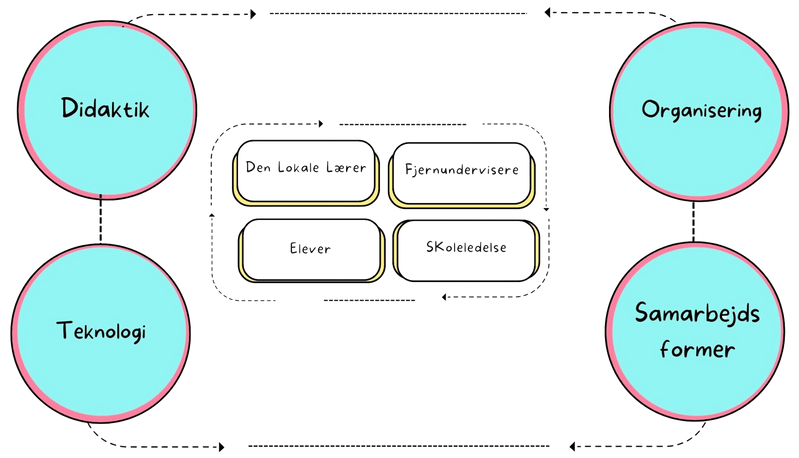
We have tried to illustrate these in the figure below. In the four circles in the middle, we have placed the four important roles or stakeholders in distance learning: the distance learning teacher, the local teacher, the pupils and school management. All four are important in different ways in order for distance learning to work in the best way possible.
In the outermost ring, we have placed the framework factors that have be considered in order to support effective distance learning. Based on the lessons learnt on the project, we have identified four main factors: didactics, organisation, technology, and forms of collaboration.
The Rural Model
The Colleague Model
The Subject Teacher Model
Kivitsisa’s distance learning course in primary and lower secondary schools in Greenland includes three different models for the application of distance learning. We have called the three models
the Rural Model, the Colleague Model and the Subject Teacher Model..
The three models illustrate three general forms of distance learning which can be used for inspiration and which are particularly relevant for schools embarking on distance learning.
The distance learning teacher may be associated with the pupils’ school as subject, didactic, educational or process consultant.
Further information about the three models can be found below. We also provide ideas for how to approach distance learning at your school or in your municipality.
In the review of each model, we will focus on the four important framework factors for distance learning: didactics, organisation, technology and forms of collaboration and the four roles involved: the distance learning teacher, the local teacher, school management and pupils.
Please note that there are topics that repeat in each model – sometimes with the same text, sometimes with variations. This is because certain issues are the same and are equally important to decide on and to take clear and explicit responsibility for – irrespective of the model used.
The knowledge presented is based on primary and lower secondary schools in Greenland, but includes perspectives that can be applied to distance learning in general – both in Greenland and internationally.


